Blog
Claude Legal just dropped.
Anthropic is targeting legal departments and law firms through Claude Cowork: deep contract review, NDA triage, compliance, playbook-driven redlines, and automated risk analysis.
This isn’t feature creep. This is a calculated takeover of one of the highest-margin, slowest industries.
After Code, now Legal.
The pattern is obvious.
Most lawyers are still comforting themselves with “I write good prompts.”
The real game is owning the entire workflow.
Leverage is flipping.
Either you use it, or your competitor uses it to crush you.
Claude coming for you.
May 14, 2026
Every new AI model release kills hundreds of startups overnight.
And nobody talks about it.
A new GPT drops. A new Claude update ships. A new Gemini release hits.
Somewhere, a founder's 18 months of work just became irrelevant.
Not because they built badly. Not because they failed to execute.
Because the foundation they built on just swallowed their product whole.
You're not competing with other startups anymore. You're competing with the infrastructure you depend on.
OpenAI can kill your startup with a changelog. Anthropic can make your product redundant in a blog post. Google can erase your market with a single model update.
The graveyard is already full.
AI wrappers. Copilot alternatives. Writing tools. Code assistants.
Hundreds of them. Gone. Not acquired. Not pivoted. Just gone.
The brutal truth:
If your moat is the model, you have no moat. If your product is a thin layer on top of an API, you are one release note away from irrelevance.
The only survivors have deep distribution, proprietary data, or workflow lock-in no update can replace.
Everything else is borrowed time.
Build accordingly.
April 23, 2026
Every new AI model release kills hundreds of startups overnight.
And nobody talks about it.
A new GPT drops. A new Claude update ships. A new Gemini release hits.
Somewhere, a founder's 18 months of work just became irrelevant.
Not because they built badly. Not because they failed to execute.
Because the foundation they built on just swallowed their product whole.
You're not competing with other startups anymore. You're competing with the infrastructure you depend on.
OpenAI can kill your startup with a changelog. Anthropic can make your product redundant in a blog post. Google can erase your market with a single model update.
The graveyard is already full.
AI wrappers. Copilot alternatives. Writing tools. Code assistants.
Hundreds of them. Gone. Not acquired. Not pivoted. Just gone.
The brutal truth:
If your moat is the model, you have no moat. If your product is a thin layer on top of an API, you are one release note away from irrelevance.
The only survivors have deep distribution, proprietary data, or workflow lock-in no update can replace.
Everything else is borrowed time.
Build accordingly.
April 23, 2026
Vercel Just Collapsed.
In April 2026, Vercel suffered a major security disaster.
Hackers gained access to their internal systems through a compromised third-party AI tool. This wasn’t a small data leak it was a full-blown security massacre.
While the company is trying to downplay it, the truth is brutal:
In their rush for hypergrowth and AI hype, Vercel completely neglected security and infrastructure.
Result:
Trust among developers has been shattered.
Many teams have already started planning their exit from Vercel.
Vercel is no longer the “deploy and forget” platform.
It has entered the “deploy and pray” era.
Hypergrowth always comes at a price.
Vercel is paying it right now.
April 20, 2026
Problem Selection in Startups
Problem selection is the foundation of everything. Choose the wrong one and everything else becomes much harder.
Pay close attention to these:
Is there real pain? Are people actually suffering from this problem?
Are they willing to pay to solve it?
Is the problem frequent and recurring?
Is the market growing?
Do you have a unique advantage in this problem?
Is the competition too crowded or is it a relatively empty niche?
The most important rule:
Don’t solve the problem you want to solve.
Solve the problem that people genuinely suffer from and are willing to pay for.
If you pick the right problem, everything becomes easier.
If you pick the wrong one, every step becomes 10 times harder.
Talk to people, listen carefully, and observe a lot. Don’t rush.
This is the most critical decision in your entire startup journey
April 19, 2026
Problem Selection in Startups
Problem selection is the foundation of everything. Choose the wrong one and everything else becomes much harder.
Pay close attention to these:
Is there real pain? Are people actually suffering from this problem?
Are they willing to pay to solve it?
Is the problem frequent and recurring?
Is the market growing?
Do you have a unique advantage in this problem?
Is the competition too crowded or is it a relatively empty niche?
The most important rule:
Don’t solve the problem you want to solve.
Solve the problem that people genuinely suffer from and are willing to pay for.
If you pick the right problem, everything becomes easier.
If you pick the wrong one, every step becomes 10 times harder.
Talk to people, listen carefully, and observe a lot. Don’t rush.
This is the most critical decision in your entire startup journey
April 19, 2026
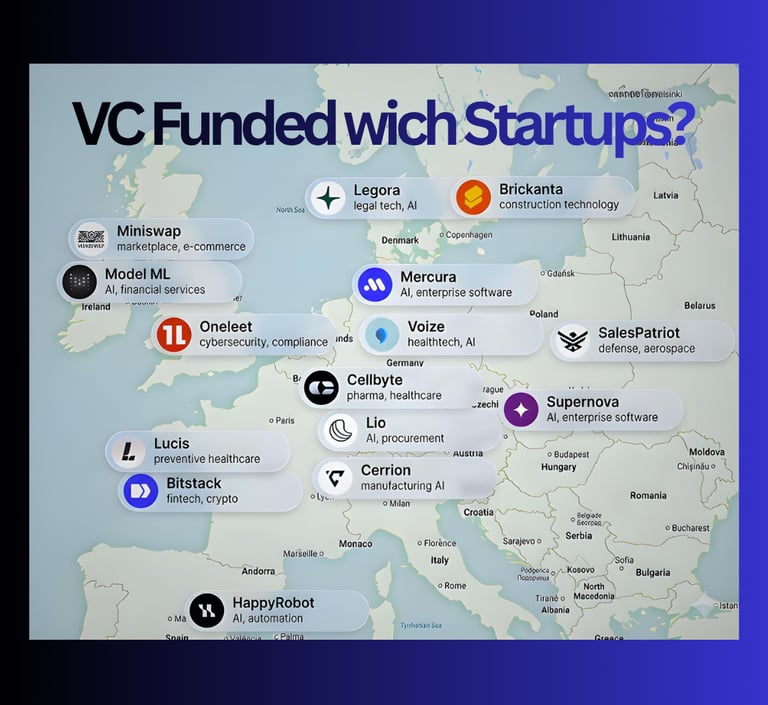
Y Combinator’s strong push into Europe is now impossible to ignore 🇪🇺
Here are 15 remarkable startups they've backed in the last 7 months:
1- Legora → legal tech AI, Stockholm, Sweden ($5.5B valuation) - Max Junestrand, Sigge Labor
2- voize → AI companion for nurses, Berlin, Germany ($50M raised) - Fabio Schmidberger, Marcel Schmidberger, Erik Ziegler
3- HappyRobot → AI agents for logistics, Madrid, Spain ($44M raised) - Pablo Palafox, Javi Palafox, Luis Paarup
4- Lio (formerly askLio) → AI procurement automation, Munich, Germany ($30M raised) - Vladimir Keil, Lukas Heinzmann, Till Wagner
5- Oneleet → cybersecurity compliance, Amsterdam, Netherlands ($33M raised) - Bryan Onel, Ora Onel
6- Cerrion → manufacturing AI video agents, Zurich, Switzerland ($18M raised) - Nikolay Kobyshev, Karim Saleh
7- Model ML → AI for financial services, London, UK ($75M raised) - Chaz Englander, Arnie Englander
8- Mercura (YC W25) → AI quote automation for construction, Munich, Germany - Lukas Bock
9- Brickanta → AI construction estimation, Stockholm, Sweden ($8M raised) - Linus B., Lucas Otterling
10- Lucis (YC P25) → preventive healthcare, Paris, France ($8.5M raised) - Max Berthelot, Baptiste Debever
11- Bitstack → Bitcoin savings for Europe, Paris, France - Alexandre BLANC
12- Cellbyte → AI for pharma drug launches, Munich, Germany - Felix Modesto Neto, Daniel Moreira
13- SalesPatriot → defence procurement, Warsaw, Poland ($5M raised) - Maciej Szymczyk
14- SuperNova → AI product development, Prague, Czechia ($9.2M raised) - Jiri Trecak, Oskar Koristka
15- Miniswap → marketplace for tabletop games, Cambridge, UK ($3.5M raised) - Will Hanna, Zak Singh
10 out of 15 are building AI for regulated, complex industries.
That's not a coincidence; it's a signal.
Healthcare, legal, finance, construction, defence, manufacturing. These aren't the easiest markets to crack, but that's exactly the point. The harder the problem, the deeper the moat.
YC clearly understands this so every ambitious founder should too.
April 14, 2026
The Biggest Mistakes I Made 2 Years Ago.
When building BinerGo I made some serious errors.
We had only one core feature - automatically turning user data into clean reports and insights.
But instead of building a simple MVP, I tried to create a full enterprise-grade system from day one.
I jumped straight into:
-Microservices architecture
-Kubernetes and Docker Swarm
-6 separate services Kafka, gRPC, Terraform, and other heavy tools Trendy stack: NestJS, TimescaleDB, Elasticsearch, LangChain The worst mistake was this:
Instead of talking to real users and getting feedback, I built features based on my own assumptions.
I spent weeks developing complex systems like “advanced filtering” because I thought users would definitely need it.
Result:
I built a very modern and technically impressive product.
But it was way too complicated and heavy for individual users.
Nobody used it.
The lesson was painful but clear:
For B2C products, simplicity is everything.
Over-engineering and premature complexity killed my first startup.
I now build everything much simpler and user-first.
Never give up..
April 12, 26
Niche selection, team building, MVP creation and marketing are not separate steps.
They are tightly connected and each one multiplies the power of the others.
Choosing the right niche is the foundation.
It makes every subsequent step easier and dramatically increases your chances of success.
A wrong niche makes even the best team and product struggle.
Building the right team turns that niche into reality.
Without strong people you cannot move fast or execute well..
Creating a clean and fast MVP is how you test your assumptions in the real world.
Speed and clarity here determine how quickly you learn.
Marketing is the oxygen that makes everything visible.
The best niche, team and product mean nothing if nobody knows they existt.
These four elements are not just important.
They are everything in a startup.
If any one of them is weak, the others lose most of their value.
When all four are strong and aligned, your odds multiply..
Master these four and everything else becomes much easier.
Ignore or underestimate any of them and the whole journey becomes ten times harder.
April 11, 26
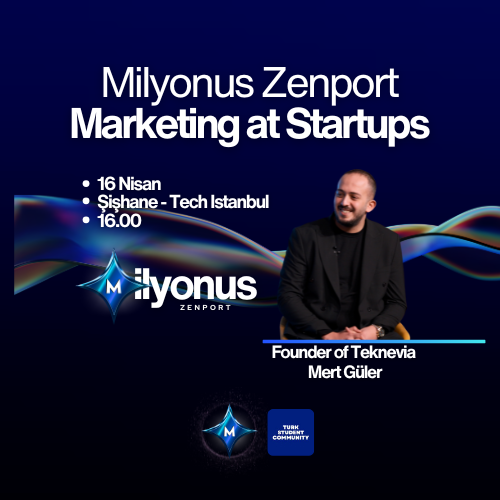
Growth doesn't happen by accident. It's engineered and most founders have no idea how.
On April 16th, I'll be joining a powerful event in Istanbul:
📌 Marketing at Startups – Milyonuss Zenport
🗓 April 16, 2026 | 4:00 PM – 6:30 PM
📍 Tech Istanbul | Şişhane, Beyoğlu, Istanbul
Organized by Milyonuss INC in collaboration with Turk Student Community, this event brings Mert Güler - founder of Teknevia- to the stage to talk about what actually works in startup marketing.
No fluff. No theory. Real field data.
→ How to get your first 1,000 users from scratch
→ The real difference between growth and marketing
→ Brand vs. performance in early-stage startups
→ The true cost of choosing the wrong channel
→ How to measure real traction
This isn’t a talk where you sit and listen. You ask questions, debate, and leave with actionable insights for your own venture.
🔗 Register here: https://luma.com/lgrddxd3
April 10, 26
You become lonelier as you rise.
I’ve seen this clearly on my founder journey.
In the beginning, everything was shared.
We’d debate ideas with my cofounder until sunrise. When the team was small, everyone was in the same boat.
Decisions felt lighter.
As the company grew, everything changed.
Now I make the tough calls alone.
The strategy battles, investor pressure, internal politics, and the regret of hiring the wrong person I carry all of it by myselff.
As the team gets bigger, the distance between us grows.
What used to be “we” slowly turns into “I.” People become more careful around you.
They hesitate to speak their real thoughts. And you can’t be fully open with them either, because every word you say now carries more weight.
The hardest part is this:
At the top, almost no one truly understands what you’re going through.
Nobody fully gets the pressure, the loneliness, or the weight you carry.
The higher you climb, the lonelier it gets.
This is one of the harshest and most real truths of being a founder.
Success brings loneliness with it.
If you don’t accept it, you’ll break halfway.
April 4, 26
On March 31, 2026, Anthropic accidentally leaked the entire source code of Claude Code. A 60MB source map file was mistakenly included in the npm package, exposing over 512,000 lines of code and 1,900 files.
This was not an intentional open-source release. Anthropic described it as a packaging error caused by human mistake.
Later, it was revealed that this was not a simple accident. The company faced serious internal questions about whether the leak was truly unintentional, raising doubts in the industry.
What’s next?
The code is now permanently available online with multiple mirrors. The community is already analyzing the architecture, agent system, memory management, and unreleased features. Competitors will likely use this to strengthen their own coding agents and tools.
This incident has damaged Anthropic’s image of tight control and security. Even if it started as a mistake, the consequences are very real and will accelerate competition in the AI coding space.
In short, Anthropic unintentionally handed its playbook to the entire industry.
April 2, 26
AI now writes most of the code. Writing good code is no longer enough everyone can do that.
The most valuable engineer is no longer the one who writes code.
It’s the one who thinks in systems, builds architecture, and makes the right trade-offs.
AI does 70% of the work. Your job is to manage and clean up the remaining 30%.
Technical depth alone is not enough anymore. You need to understand product logic and deliver real business outcomes.
The ability to learn fast and adapt has become more important than old knowledge.
Short Advice:
Treat AI as your strongest assistant, not your competitor. Learn to direct it extremely well.
Develop systems thinking.
Go deep in one area.
Improve your communication skills.
Learn something new and difficult every 6-8 months.
Summary:
The winners are no longer “good coders.”
They are engineers who use AI effectively, build systems, and deliver real results.
If you don’t adapt quickly, you will become obsolete very fast.
March 31, 26
When building a brand, the most important thing is not the product itself it’s the psychological impression you leave in people’s minds.
People don’t remember brands with logic. They remember them with emotion.
A nice logo or clever slogan is not enough.
The real power lies in the psychological style you create.
Does your brand make people feel trust?
Excitement?
Luxury?
Closeness?
Innovation?
This emotional imprint sinks into the subconscious and drives decisions.
People may justify their choices with logic, but they buy, follow, and recommend based on how the brand makes them feel.
True branding is not about selling a product.
It’s about leaving a specific feeling and personality behind.
Products can be forgotten.
But the feeling you leave stays for years.
Strong brands understand this:
They don’t just want to live in people’s heads they want to live in their emotions.
If you don’t clearly define your psychological style, your brand will stay scattered and weak.
Define it well, and your brand becomes memorable and powerful.
March 29, 26
When building a brand, the most important thing is not the product itself it’s the psychological impression you leave in people’s minds.
People don’t remember brands with logic. They remember them with emotion.
A nice logo or clever slogan is not enough.
The real power lies in the psychological style you create.
Does your brand make people feel trust?
Excitement?
Luxury?
Closeness?
Innovation?
This emotional imprint sinks into the subconscious and drives decisions.
People may justify their choices with logic, but they buy, follow, and recommend based on how the brand makes them feel.
True branding is not about selling a product.
It’s about leaving a specific feeling and personality behind.
Products can be forgotten.
But the feeling you leave stays for years.
Strong brands understand this:
They don’t just want to live in people’s heads they want to live in their emotions.
If you don’t clearly define your psychological style, your brand will stay scattered and weak.
Define it well, and your brand becomes memorable and powerful.
March 29, 26
Here's the original English text, cleaned up and formatted:
The AI Bubble Is Starting to Deflate
In 2025-2026, AI hype reached its peak. Billions of dollars poured in, valuations skyrocketed. Yet real-world adoption and revenue are lagging far behind the hype. Compute costs are astronomical, inference economics are getting tougher, and many AI startups are still burning cash.
The most striking example right now: OpenAI is shutting down Sora.
When Sora was unveiled in 2024, it was hailed as the tool that would "end traditional video production." It generated shockingly realistic videos and even scared Hollywood. In 2025, it launched as a standalone app, and OpenAI even signed a major deal with Disney.
But in March 2026, OpenAI quietly announced it was shutting Sora down. Both the consumer app and the professional service are being discontinued. The Disney partnership has also been canceled.
Why did they kill it?
Compute is extremely expensive and limited. Heavy video models like Sora consume massive amounts of GPU power.
OpenAI is redirecting resources to higher-priority areas: advanced reasoning, agentic AI, and especially robotics.
The video generation market became crowded fast — Runway, Kling, Luma, Pika, and others. Competition intensified, and differentiation got much harder.
User adoption and long-term demand fell well below expectations.
This move perfectly summarizes the current reality in AI:
There is still a huge gap between hype and actual usage. Creating impressive demos is easy. Getting millions of people to use it in daily life is much harder.
The bubble hasn't fully burst, but it's starting to deflate.
The winners will be those who move away from "cool tech" and focus on solving real problems, controlling costs, and building sustainable business models.
Sora's shutdown is a clear sign that the "let's do everything" era is slowly ending.
It's time to focus.
March 26, 26


In 2025-2026, AI hype reached its peak. Billions of dollars poured in, valuations skyrocketed. Yet real-world adoption and revenue are lagging far behind the hype. Compute costs are astronomical, inference economics are getting tougher, and many AI startups are still burning cash.
The most striking example right now: OpenAI is shutting down Sora.
When Sora was unveiled in 2024, it was hailed as the tool that would “end traditional video production.” It generated shockingly realistic videos and even scared Hollywood. In 2025, it launched as a standalone app, and OpenAI even signed a major deal with Disney.
But in March 2026 (around March 24), OpenAI quietly announced it was shutting Sora down. Both the consumer app and the professional service are being discontinued. The Disney partnership has also been canceled.
Why did they kill it?
Compute is extremely expensive and limited. Heavy video models like Sora consume massive amounts of GPU power.
OpenAI is redirecting resources to higher-priority areas: advanced reasoning, agentic AI, and especially robotics (solving real-world physical tasks).
The video generation market became crowded fast (Runway, Kling, Luma, Pika, etc.). Competition intensified, and differentiation got much harder.
User adoption and long-term demand fell well below expectations.
This move perfectly summarizes the current reality in AI:
There is still a huge gap between hype and actual usage.
Creating impressive demos is easy. Getting millions of people to use it in daily life is much harder.
The bubble hasn’t fully burst, but it’s starting to deflate.
The winners will be those who move away from “cool tech” and focus on solving real problems, controlling costs, and building sustainable business models.
Sora’s shutdown is a clear sign that the “let’s do everything” era is slowly ending.
It’s time to focus.
March 26, 26
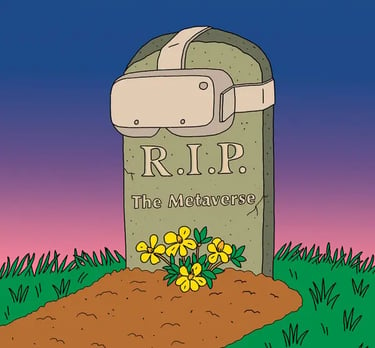
80 Billion Dollars Spent… Now Quietly Shutting Down the Metaverse!
What was once hyped as “the future of the internet” has become one of the most expensive failures in tech history
In 2021, Mark Zuckerberg renamed the company Meta and poured a staggering 80 billion dollars into Reality Labs. VR headsets, Horizon Worlds, virtual offices, avatars everything was built.
There was just one thing missing: People actually wanting it.
The hype was massive. People tried it, played around for a bit, then quietly returned to real life.
Now the decision is clear: In March 2026, Meta largely removed Horizon Worlds from Quest VR headsets and shifted focus entirely to AI and its existing platformss Instagram, Facebook, and WhatsApp.
The lesson from this story is painful but crystal clear:
If you build technology for users instead of for real user needs, no matter how much money you throw at it, all you end up with is an extremely expensive lesson.
Hype can never replace product-market fit.
Zuckerberg learned this the hard way with 80 billion dollars
One of the most expensive lessons in tech history.
March 25, 26
Leaders are not born. They are forged.
You don’t become a leader through talent, intelligence, or charisma.
You become a leader through the hard shit you go through.
The real challenges. The failures. The crises.
The moments when everything is on the line.
No struggle, no leadership.
The tougher the battles you face and overcome, the stronger the leader you become.
Comfort creates followers. Adversity creates leaders.
March 24, 26
The first 3–5 months after MVP launch decide if your startup lives or dies.
This window is brutal because everything is exposed raw: hypothesis validity, user arrival, retention depth, willingness to pay, and real feedback value.
Product-market fit either ignites or fades silently here.
Retention curves must trend up fast or the signal is death. Churn above 15% monthly erodes momentum irreversibly. Early users either become passionate advocates or vanish without trace.
From an investor perspective this period is traction or bust. Weekly active users, engagement depth, NPS scores, and viral coefficients either accelerate or stall. Stagnation triggers pivot pressure. Upward movement opens scale conversations.
Founders fall into classic traps during these months: piling on features instead of ruthless focus, clinging to roadmap over user pain, burning out in solo mode, or ignoring hard metrics for gut feel.
Most startups perish quietly in this exact timeframe through slow bleeding or founder exhaustion.
The survivors share one obsession: listen deeply to users every week, cut wrong assumptions quickly, track metrics religiously, and bury bad hypotheses within 2–3 months.
Core truth: MVP launch marks the beginning of the real survival test, not the end of the hard part.
These months offer the widest margin for error you will ever have. Use that margin to learn aggressively and pivot without mercy.
Treat them lightly and the startup disappears. Nail them ruthlessly and the path forward suddenly opens wide.
March 21, 26
Building a startup and raising millions is now dramatically easier and faster thanks to the latest frontier LLMs.
What used to take 6-12 months, 5-10 engineers, and $500k-$1M burn can now happen in 1-4 weeks with 1-2 people or even solo.
Gemini 2.5, Claude 4.5, Grok 4, DeepSeek V3 and similar models handle code, UI, backend, APIs, initial copy, even pitch deck drafts.
Investors love it. YC, a16z, Sequoia chase AI-native teams. A deck line like "built MVP in 3 weeks using frontier models" often beats traditional traction metrics for pre-seed and seed rounds.
But founders must watch these hard realities:
Hallucinations and non-deterministic outputs still kill production. Human oversight is non-negotiable.
LLMs commoditize speed but do not create moats. Everyone uses the same models, so defensibility comes from proprietary data, distribution, or deep vertical expertise.
Inference costs explode at scale. Model your economics early or runway vanishes in months.
Solo AI speed is great for launch but lethal for growth. Without cofounders or early hires you hit a wall fast.
The single most important key point:
LLMs make starting trivial.
Winning is still brutally hard.
Rapid prototyping is free.
Solving the right problem, creating user addiction, building real moats, and executing flawlessly remain 100% on you.
AI gets you to the door.
Raising millions and surviving inside still depends on your vision, grit, and ruthless execution.
Move fast to start.
Move smarter to last.
Everyone is fast now. Winners are the ones who stay alive longest.
March 20, 26
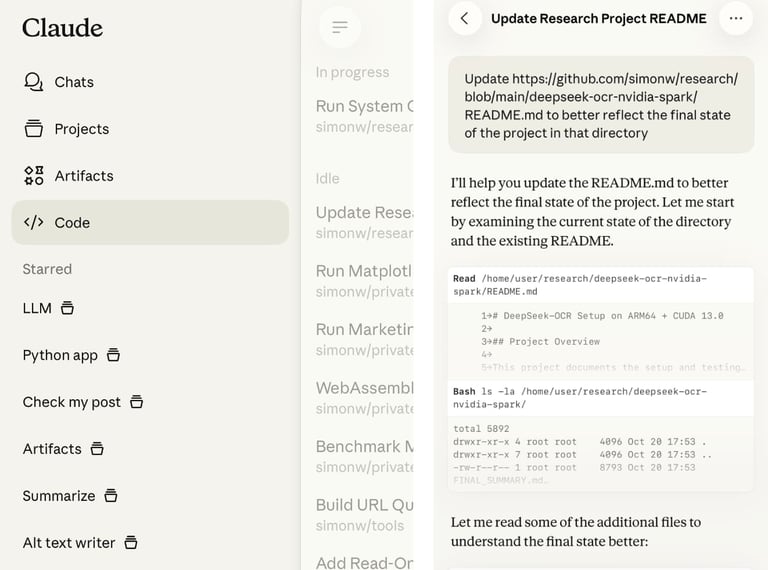
Claude Code now has persistent memory thanks to Claude-Mem.
This open-source tool records everything during coding: tool calls, bug fixes, decisions, observations. It compresses them semantically, slashes tokens by up to 95%, and injects the summary automatically in future sessions.
The model remembers the project, knows past choices, picks up exactly where it left off..
Difference from Anthropic's official Memory Tool is clear.
Official one is RAM: lives only in the current session, bound by context window.
Claude-Mem is hard drive: persists across sessions, long-term memory.
Together they create full project continuity: instant + durable recall.
real talk: Anthropic's tool helps agents but doesn't fix Claude Code's amnesia problem new session means everything resets. Claude-Mem fills that gap with local SQLite, auto-capture, compression, multilingual supportt.
For developers this is huge. Multi-day projects lose the "where were we?" friction. Context continuity boosts speed, cuts errors, gives true agent feel.
If Anthropic doesn't ship native persistent memory soon, community will keep closing the gap.
Right now Claude Code + Claude-Mem is one of the strongest persistent coding setups out there.
If you're doing long-running code work, try it. It kills amnesia dead.
March 19, 26
What is the secret to creating something unique?
Is it necessary to have abilities that only a few people possess?
Ideas become clearer as you put more effort into them, yes we know this.
but probably the answer is:
You just have to believe in an idea that people call stupid for long enough.a
March 17, 26


Technology has accelerated massively in the last 3 years because AI became the ultimate force multiplier and it keeps rewriting every rule.
AI isn't just another tool. It's self-improving infrastructure that turbocharges everything else.
Code generation is prototypes in minutes instead of weeks.
Research loops is hypothesis → experiment → analysis in hours.
Chip design is better hardware → stronger models → even faster progress.
The feedback loop is viciously tight now.
Data + compute scaling + algorithmic breakthroughs (unhobbling, reasoning chains) combined. Performance jumps 10,000x in some domains since 2023. Adoption exploded faster than any tech in history.
The real game-changer: AI bypasses human cognitive bottlenecks. Pattern recognition, optimization, creativity at machine speed. What used to take years now takes days or hours.
Result: every sector gets compressed timelines. Drug discovery, software dev, materials science, robotics all on steroids.
This isn't hype. It's the fastest period in tech history because AI turned progress into an exponential compound engine.
The pace won't slow anytime soon. The loop is only getting stronger.
Early adopters win big. Everyone else gets left explaining why things "used to be slower."
March 16, 26
Europe's tech scene in 2026 is strangled by over-regulation and structural traps.
EU AI Act DMA DSA NIS2 pile endless compliance costs. Founders burn time on lawyers instead of code.
Sovereignty talk slows AI cloud adoption. Enterprises lag US by years in genAI. Talent flees to US for better pay visas scale. Funding stays fragmented conservative no mega-round culture. Deep tech starves while safe bets eat capital. US cloud dependence risks outages export controls political shutdowns. Turnover barely positive after brutal years.
Turkish tech market shines as exception.
Young English-speaking devs massive government push AI target 5% GDP tech zones Turcorn incentives. Funding holds strong 1.4B in 2025 resilient despite no unicorns exploding.
Domestic digital boom fintech gaming defense e-commerce payments. Fast iteration low costs export mindset Istanbul rising fast. While Europe debates rules Turkey builds ships scales.
Europe has brains ideas execution unity missing. Turkey prioritizes speed leverage over perfection.
March 15, 26
Meetings wrap, talk evaporates, same bullshit gets re-litigated next week. Speed bleeds out instantly: rehashing murders momentum, drags pivots, postpones real work. Quick teams survive the early bloodbath. Lazy ones evaporate.
Mistrust follows right behind. “We settled that.”
“Bullshit we did.” “No one wrote a damn thing.” Suspicion infects cofounders, poisons the team, alerts investors. One fuzzy call breeds bitterness. A stack of them and your best people ghost.
Cash torches quicker when no one owns shit. Work doubles up. Balls drop. Wrong features ship.
Dollars burn on dumb experiments. Sloppy follow-through kills way more startups than no customers ever will.
Chaos flat-out refuses to scale. Tiny crew might fake it with brains and DMs. Mid-size hurts bad. Bigger size detonates. Ignore the mess early and you slam into a wall no Series A fixes.
You become the walking hard drive. Every question boomerangs to your skull. Fatigue piles up. Calls get worse. Death spiral engages.
Untracked decisions aren't harmless admin noise.
They're straight poison. They rot time, relationships, runway, focus, will—the only shit that matters.
This isn't corporate fluff. It's air.
Skip it and you start feeling unstoppable… then heavy… then gone.
Lock it down from day one and traction, revenue, funding, morale all snap into gear.
Most founders learn the hard way after torching time, talent, money.
Winners treat brutal clarity and hard ownership like breathing. No negotiation. No mercy.
March 14, 26
The 3 must-have skills every startup founder needs (no exceptions):
1- Ruthless prioritization & the art of saying no Time is your only non-renewable asset. You’ll have to kill 99 ideas out of 100. The reflex isn’t “yes” when a customer asks it’s “no, but here’s what we can do instead.” Dying early on the wrong product beats dying late on the right one. The founder’s deadliest sin: trying to do everything.
2- Fast, high-quality decisions under extreme uncertainty Data is scarce, ambiguity is infinite, runway is short. Your job isn’t perfect decisions it’s good-enough + fast decisions. Master the 80/20 rule: 20% information → 80% accuracy. When wrong, correct course fast (not dramatic pivot, just small steering). Indecision is the most expensive mistake you’ll ever make.
3- Reading people & building deep trust Nothing happens without people: money, product, hires, cofounders all human. Convincing investors, first customers, top engineers, partners… same core skill: Reading their fears, motivations, egos and speaking on their exact frequency. Trust isn’t built in a day, but it can vanish in one sentence.
The founder’s ultimate leverage: people saying “this person keeps their word.”
Without these three, every other skill (coding, sales, marketing, fundraising) stays stuck.
Because startups run on people, time, and decisions, nothing else
Which one do you find the hardest?
March 9, 26
The trend is crystal clear:
Capability compresses decision cycles.
Cost crushes everything else.
Picking the wrong model burns your speed and your money.
Picking the right one turns it into leverage.
LLM race in March 2026: at peak intensity and total chaos.
Frontier models right now:
OpenAI GPT-5.x → still leads in raw reasoning & agentic workflows,
GPQA ~92% Google Gemini 3.x → tops blind arenas (LMArena), 1M+ native context, multimodal beast
Anthropic Claude 4.x → best at clean code, nuance, reliable high-fidelity output (SWE-bench ~80%+) xAI Grok 4 → math/research powerhouse, blazing fast & dirt cheap
Chinese pack (DeepSeek R1/V3, Qwen 3, GLM-4) → insane speed-to-cost ratio, matching or beating in many domains No more single “smartest model.”
Specialization wins. Token costs have collapsed (per 1M tokens, approx.):
GPT-5 family → $1–30 input / $10–180 output (mini/light versions $0.05–0.40)
Claude 4 → $3–15 input / $15–75 output
Gemini 3 → $0.50–2 input / $3–12 output (cheapest high-context value)
Grok 4 → $0.20–3 input / $0.50–15 output (fast modes extremely aggressive)
Chinese leaders → $0.10–0.50 input / $0.30–2 output (often 50%+ cheaper at near-parity perf)
The race isn’t about who has the absolute highest benchmark today. It’s about who controls inference economics at scale.
Choose wrong → you pay twice. Choose right → everything accelerates.
March 7, 26
I'm not so sure how things are going these days.
It feels like life has become knotted all of a sudden.
It's not the number of problems, but how they intertwine that hurts more.
As one tries to be resolved, the other wraps itself even tighter.
While one collapses on you like a blanket, the other wraps around your throat like a pillow.
A small problem
sleepless nights
loss of concentration
mistakes, even more stress
no problem, we love stress
Problems are heavy even on their own.
The important thing is to be able to solve problems before they become complicated and entangled.
March 6, 26


A closed mouth never gets fed.
March 5, 26
A network is not built instantly.
It grows like a tree.
At first it looks small. Few connections, few opportunities, little influence. That is why many people give up early. But a network grows over time. Every meeting, every collaboration, every act of trust strengthens the roots..
Years later, that small seed becomes a strong tree. People know you, trust you, and opportunities begin to flow toward you.
The strongest networks are not built quickly.
They are grown patiently over the long term.
March 5, 26
AI Companies Join the Israel War Between Iran and America...
Here's the new and disturbing reality of the startup world: it's no longer just software companies competing. States are also competing. And artificial intelligence companies are being drawn into the middle of this game.
The picture has become clear in recent weeks.
Anthropic did not accept some of the usage conditions that the Pentagon wanted for its Claude model. The company specifically opposed the use of AI in:
* fully autonomous weapons
* mass surveillance
* direct lethal operations
CEO Dario Amodei explicitly stated that such use carries ethical and security risks.
But the void did not remain empty for long.
OpenAI made its own agreement with the Pentagon and provided its models for use in defense systems. This decision drew serious reactions, and even user boycotts began.
There is an important nuance here, let's not romanticize it:
OpenAI says it has established principles prohibiting the use of AI in autonomous weapons or internal surveillance.
However, there is criticism that the agreement does not legally bind these prohibitions.
The Pentagon, on the other hand, wants to use AI aggressively in operational planning and intelligence processes.
So the real picture is not black and white. But the trend is very clear:
Big AI companies are being drawn into the defense and killing ecosystem.
OpenAI disclosed its ethical boundaries to everyone.
And the truly disturbing conclusion is this:
This is not a "future scenario."
This has already begun.
One foot of the AI race was in Silicon Valley.
The other foot is now directly within war doctrines.
March 4, 26
Software used to wait for commands.
Now it observes, decides, and acts.
For years, software was passive. Humans thought. Systems executed.
That model is changing..
AI agents are turning static tools into active systems.
They can plan tasks, call tools, evaluate outputs, and iterate toward goals. What once required constant human coordination can now be partially automated.
But let’s stay realistic.
Agents are not independent minds.
They are probabilistic systems built on models, memory, and structured workflows.
Without guardrails, context control, and clear architecture, they fail..
The radical shift is this:
We are moving from interface driven software to objective driven systems.
Instead of telling software how to do something,
we define what we want done.
The future of software belongs to systems that can operate with limited supervision and continuous feedback.
Writing code is becoming cheaperr.
Designing intelligent systems is becoming more valuable.
Software is no longer just a tool.
It is becoming an actor.
March 3, 26
Innovation is rarely born from brilliance.
It is born from attention.
I remember noticing a small detail during a product test.
Users were not struggling with complex features.
They were struggling with the simplest step in the flow..
Everyone focused on advanced functionality, but the real problem was basic friction.
That moment revealed something important.
The biggest opportunities often hide inside the smallest inefficiencies.
People try to solve massive problems, yet ignore the daily obstacles right in front of them.
Innovation begins when you question the obvious.
Why is this slow? Why is this confusing? Why does this exist at all?
Constraints also teach this lesson.
Limited resources, imperfect tools, and broken systems force new thinking.
When perfect conditions disappear, creativity becomes necessary.
To innovate, you must train perceptionn.
See what others normalize.
Question what others accept.
Design what does not yet exist..
Innovation is not an event.
It is a way of seeing.
The future is shaped not by those who wait for big ideas,
but by those who notice small problems and refuse to ignore them.
March 1, 26
Vibe coding is changing how software gets built.
It is fast, interactive, and powered by large language models that generate code in real time.
Today, this approach is driven by technologies from OpenAI, GitHub, and Anthropic.
Code generation, intelligent suggestions, and strong context processing dramatically reduce the cost of experimentationn.
The short term impact is clear.
The distance between idea and prototype is now measured in minutes.
Early stage teams can test faster, build faster, and iterate without heavy engineering overhead.
Vibe coding creates massive leverage for exploration and rapid product development.
But in its current form, it is not enough on its own.
It is not fully deterministic.
It does not guarantee architectural consistency.
It can create hidden technical debt and fragile systems..
Production level software still requires deliberate design, clear structure, and human judgment.
The realistic future is not rejection, but evolution.
Vibe coding will merge with agent based supervision, stronger context engineering, and structured system design.
Writing code will become cheaper.
Designing correct systems will become more valuable..
Developers will not disappear.
But developers who only write code, without understanding systems, architecture, and reasoning, will lose relevance.
Feb 28, 26
Product market fit is the hardest milestone in a startup.
And without it, nothing else matters.
You can have great technology, strong branding, and fast execution.
If the market does not truly need your product, growth will always be forced and temporary.
Product market fit means one simple reality:
people want your product without being pushed.
Reaching that point is difficult because:
• Founders often fall in love with solutions instead of problems
• Early feedback can be misleading or too polite
• Real user behavior is different from user opinions
• Markets change faster than assumptions
• Iteration requires patience, discipline, and constant learning
But its importance is absolute.
Product market fit reduces customer acquisition cost.
It creates organic growth.
It turns users into advocates.
It makes scaling possible.
Before product market fit, every growth effort feels heavy.
After product market fit, growth becomes naturall.
Startups do not scale ideas.
They scale demand..
Finding product market fit is not a step in the journey.
It is the moment the journey truly begins.
Feb 26, 26
In startups, chaos kills faster than competition.
Most startups do not fail because the idea is bad.
They fail because the team does not know who is responsible for what.
Unclear roles create slow decisions, duplicated work, and silent failuress.
Task distribution is not management. It is execution architecture.
When ownership is clear, speed increases.
When ownership is unclear, everything breaks.
The critical technical foundations:
• Single ownership → Every core area has one responsible person, not shared responsibility.
• Explicit role boundaries → Product, engineering, growth, and operations must be clearly separated.
• Decision authority defined → No confusion about who makes the final call.
• Process documentation → Repeatable workflows, not tribal knowledge.
• Async execution systems → Task tracking, logs, and clear updates instead of constant meetings.
• Outcome driven metrics → Measure impact, not effort.
Early stage teams are small.
Small teams cannot afford confusion...
Clarity creates alignment.
Alignment creates speed.
Speed decides survival.
Strong startups are not just built on talentt.
They are built on structured responsibility.
Feb 25, 26
In modern startups, three forces create massive leverage: AI driven products, reusable value, and strong personal brands.
AI turns products into scalable intelligence.
When your product learns, adapts, and automates, value grows without proportional human effort. AI driven systems reduce cost, increase speed, and create continuous improvement..
The second advantage is simple: build once, sell repeatedly.
Software, digital tools, and platforms allow startups to create something a single time and distribute it infinitely. This model breaks the limits of traditional service businesses and creates exponential growth potential.
The third force is personal brand.
People trust people before they trust companies.. Founders who share their vision, knowledge, and journey create credibility, attract users, and open unexpected opportunities. A strong personal presence accelerates distribution, hiring, partnerships, and investmentt.
When these three combine, the impact multiplies:
AI powered products create scalable value.
Reusable products create continuous revenue.
Personal brand creates trust and reach.
Startups that master this combination do not just build products.
They build influence, distribution, and long term advantage.
Feb 24, 26
Content marketing in startups is not promotion.
It is distribution, trust, and growth. In the early stage, people do not know your product.
They first know your ideas, your thinking, and your value through content.
Content builds credibility before sales ever happen.
The advantage is simple.
Startups do not have large budgets.
But they can have a strong voice.
Clear content attracts users.
Educational content builds authority.
Transparent content builds trust. The most effective startup content strategies include:
• Sharing the building process publicly (build in public)
• Explaining the problem you solve and why it matters
• Teaching users how to use your product
• Publishing technical insights and lessons learned
• Sharing real metrics, experiments, and failures
• Creating educational videos on YouTube or thought leadership posts on LinkedIn
• Writing case studies and user success stories
Good content reduces customer acquisition cost. It creates organic growth. It turns attention into users and users into advocates. In the end, content marketing is leverage.
Products solve problems.
Content makes people discover that solution.
Feb 23, 26
In startups, ideas do not create value. Products do.
An idea is only a direction. A product is proof.
Many founders fall in love with ideas, but markets respond only to working solutions that solve real problems.
The relationship is simple.
Idea defines the vision.
Product tests the truth.
A strong idea without execution is imagination.
A shipped product without a clear idea is noise.
Real impact happens when vision meets implementation.
The market does not evaluate what you plan to build.
It evaluates what people actually use.
This is why successful startups move quickly from idea to product.
They validate assumptions, measure real behavior, and iterate based on reality.
In the end, ideas inspire.
Products survive.
Feb 23, 26
Digitalization is no longer a competitive advantage. It is a survival condition.
Across European Union economies, companies are rapidly transforming their operations into fully digital systems. From finance to logistics, from healthcare to manufacturing, data driven infrastructure is becoming the default foundation of every industry. Businesses that digitize move faster, reduce costs, and scale globally with minimal friction..
The global trend is clear. In markets led by the United States and Asia, automation, AI systems, and cloud infrastructure are redefining productivity standards. Decision making is becoming algorithmic. Operations are becoming autonomous. Speed is becoming the new currency of competition.
The risk is simple.
Companies that fail to digitalize will not slowly decline.
They will become irrelevant.
Manual processes cannot compete with automated systems.
Slow organizations cannot compete with real time intelligence.
Analog thinking cannot survive in a data driven economy.
Digital transformation is no longer about innovation strategy.
It is about economic existence.
The future will not wait for those who hesitate.
Those who digitalize will lead.
Those who resist will disappear.
Feb 21, 26
Fall to the ground. Do not get up.
Collapse. Do not get up.
Be shattered. But do not get up.
Was standing up ever your duty?
If you are either going to win or lose, there are only two outcomes.
Did you ever think there was a third option?
There was never a third option.
There will never be a third option.
You will either win or you will die.
If you die, your company dies.
Worse than death is losing your belief.
Remember the promise you made to yourself..
Bite down. And if you hold on, never let go until it breaks.
Do not let go.
Never let go.
Feb 20, 26
Most AI systems do not fail because of weak models.
They fail because of weak context..
The most critical part of context engineering is feeding the right information at the right time.
Too little context creates confusion.
Too much context creates noise.
Wrong context creates wrong decisions.!
Models think based on what they see.
If the input is unclear, the output cannot be reliable.
Good context engineering means::
• Defining clear instructions and goals
• Providing relevant data only
• Structuring information logically
• Controlling memory and history
• Removing ambiguity from prompts
''Better context → better reasoning → better results.''
AI performance is not just model quality.
It is context quality.
The system is only as intelligent as the context you design.
Feb 18, 26
Most startups do not fail because of competition.
They fail because of avoidable mistakes made early.
One of the biggest mistakes is building without validating the problem.
Speed does not matter if you are running in the wrong direction. A product nobody needs is just well executed waste.
Building without validating the problem.
Scaling before product market fit.
Choosing the wrong co founder.
Overengineering instead of shipping fast.
Ignoring real user feedback.
Losing focus by chasing too many directions.
Startups rarely die from external pressure.
They collapse from internal mistakes that could have been avoided with discipline, focus, and clarity.
Feb 16, 26
Startups don’t compete with billion-dollar companies through budget.
They win through speed of technology and innovation.
Today’s competitive edge is no longer just building products.
It is about catching technological breakthroughs early.
While large companies focus on maintaining stability, startups can change the game by being aggressive in these areas:
• AI-native product architecture → Designing products around AI from the beginning, not adding it later.
• Automation-first systems → Automating operations, support, growth, and decision processes.
• Rapid experimentation pipelines → Reducing the cycle of feature release → measurement → iteration to days.
• Cloud-native + serverless infrastructure → Maximum scalability with minimal cost.
• Data advantage → Building systems that learn fast with small but high-quality data.
• AI agents & autonomous workflows → Transforming human operations into scalable systems.
The problem of large companies is not lack of access to technology.
It is their inability to adapt quickly.
Legacy systems, bureaucracy, and fear of risk slow down innovation.
This is where the startup advantage emerges:
Fast technology adoption → fast product development
Fast product development → fast user acquisition
Fast learning → competitive advantage
The startups that will win today are those that:
– Integrate AI and agent systems into their core product
– Build engineering cultures that produce massive output with small teams
– Minimize infrastructure costs while maximizing iteration speed
– Catch technological waves early instead of following trends
The reality is simple:
Technology is always equal.
Speed of adaptation is not.
Startups do not compete with giaants.
They outpace them in technological transformation..
The future will not belong to the biggestt.
It will belong to the fastest to evolve.
Feb 15, 26
One of the biggest mistakes startup teams make is choosing projects based on hype instead of capability.
A startup should not chase what is popular.
It should build where it is strongest.
Your team’s skills, experience, and technical depth are your real competitive advantage. When you build in a space where your capabilities are high, you move faster, solve problems better, and execute with confidence. Execution becomes natural, not forced.
But when teams choose projects outside their core strengths, everything becomes heavier.
Learning curves slow momentum. Decisions become uncertain. Energy is spent catching up instead of innovating.
Great startup teams understand one simple truth:
Market opportunity matters, but team capability matters more.
The best ideas are not always the biggest ideas.
They are the ideas your team can execute better than anyone else.
Before choosing a project, ask:
Do we understand this problem deeply?
Do we have the technical strength to build it?
Do we have the experience to move fast here?
Because in startups, success rarely comes from chasing trends.
It comes from building where your strength is undeniable.
Feb 14, 26
One of the biggest mistakes startup teams make is choosing projects based on hype instead of capability.
A startup should not chase what is popular.
It should build where it is strongest.
Your team’s skills, experience, and technical depth are your real competitive advantage. When you build in a space where your capabilities are high, you move faster, solve problems better, and execute with confidence. Execution becomes natural, not forced.
But when teams choose projects outside their core strengths, everything becomes heavier.
Learning curves slow momentum. Decisions become uncertain. Energy is spent catching up instead of innovating.
Great startup teams understand one simple truth:
Market opportunity matters, but team capability matters more.
The best ideas are not always the biggest ideas.
They are the ideas your team can execute better than anyone else.
Before choosing a project, ask:
Do we understand this problem deeply?
Do we have the technical strength to build it?
Do we have the experience to move fast here?
Because in startups, success rarely comes from chasing trends.
It comes from building where your strength is undeniable.
Feb 14, 26
A startup team must be brutally aligned internally!!
Strong synchronization is not optionall.
The best startup teams operate like a single system.
They move fast, think together, and execute with consistency. Decisions are clear, communication is direct, and everyone understands the mission without confusion.
Great teams do not avoid conflict.
They handle it well.
Healthy conflict creates clarity.
It allows different perspectives to surface, challenges weak ideas, and strengthens strategy. But once a decision is made, alignment becomes absolute. No hidden resistance. No silent disagreement. Only execution.
Trust is the foundation of true synchronization.
Team members must trust each other's intentions, competence, and commitment. Without trust, every discussion becomes friction. With trust, even hard debates create progress.
Consistency builds momentum.
When a team is internally stable, energy flows into building products instead of managing tension. Speed increases. Decisions improve. Results compound.
In early-stage startups, internal chaos is fatal.
But strong alignment creates a powerful advantage.
When conflict is healthy, synchronization is strong, and commitment is shared, a startup team becomes unstoppable.A startup team must be brutally aligned internally.
Strong synchronization is not optional. It is survival.
The best startup teams operate like a single system.
They move fast, think together, and execute with consistency. Decisions are clear, communication is direct, and everyone understands the mission without confusion.
Great teams do not avoid conflict.
They handle it well.
Healthy conflict creates clarity.
It allows different perspectives to surface, challenges weak ideas, and strengthens strategy. But once a decision is made, alignment becomes absolute. No hidden resistance. No silent disagreement. Only execution.
Trust is the foundation of true synchronization..
Team members must trust each other's intentions, competence, and commitment. Without trust, every discussion becomes friction. With trust, even hard debates create progress.
Consistency builds momentum.
When a team is internally stable, energy flows into building products instead of managing tension. Speed increases. Decisions improve. Results compound.
In early-stage startups, internal chaos is fatal.
But strong alignment creates a powerful advantage..
When conflict is healthy, synchronization is strong, and commitment is shared, a startup team becomes unstoppable..
Feb 14, 26
The greatest secret of success is believing in an idea that people find stupid long enough.
Feb 13, 26
Startups should not romanticize vibe coding.
AI can generate code quickly, but it does not understand your product vision, your users, or the long-term consequences of technical decisions.
Trusting AI one hundred percent creates silent technical debt.
Things may work in the beginning, demos look great, progress feels fast. Then scale arrives, complexity grows, and weak foundations start to crack..
AI is not a replacement for engineering judgmentt.
It cannot feel where systems will break, where abstractions are wrong, or where simplicity is being sacrificed for speed.
AI should amplify strong builders, not replace them..
Let humans define the architecture, trade-offs, and direction. Let AI accelerate execution..
Feb 9, 26
Why did you want to build a zoom?
In the 4th month of building Milyonus with my team, after trying and failing to create my own Zoom within Milyonus, we chose a 3rd party service that provides the most reliable and accurate online meeting service, with the most reliable certifications, via API, and we tried to integrate it into our project.
We completed our integration in the most secure way. However, the AI agent bot we produced could not participate in these online meetings in any way.
After experiencing problems with every system that automatically assigns the bot, automatically creates the bot, and sends the bot inside, we changed the bot's language. We rewrote it from scratch using only Python instead of C.
We kept trying each system that automatically assigns the bot, automatically creates the bot, and sends the bot inside.
Finally, the 5th system that enabled internal assignment matched. We succeeded. There may be more than one option. But there may not be.
This is not a Turkish YKS exam or an EU IELTS exam.
Here, you determine the options.
You test the options.
And you determine the number of options.
Change your frameworks.
Or change your glasses, or your eyes, or your perspective, and try to succeed as I did.
Feb 8, 26
Clawdbot was born out of necessity.
There was a very specific problem, limited time, and a clear goal: build something that works. No philosophy, no branding obsession. Just execution. It did its job well. It pulled data, followed rules, and moved fast. But it was rigid. Every new requirement meant more patches, more constraints, more friction.
At some point, I noticed something uncomfortable.
The system was working, but it was resisting change. Small updates felt heavier than they should. Adding intelligence meant fighting the structure instead of extending it. That is usually the moment when people say “let’s just push through.” I did not.
The idea of molting came from that exact phase.
In nature, molting is not failure. It is survival. You grow, and the old skin becomes the problem. If you keep it, you stagnate.
Moltbot emerged quietly. No big launch, no dramatic rewrite. Just a series of deliberate decisions: removing assumptions, loosening hard rules, letting the system adapt instead of obey blindly. Over time, Clawdbot stopped feeling like the right name. It was no longer a claw. It was a system learning when to change its shape.
The rename happened almost naturally.
Moltbot was not a rebrand. It was an admission that the product had grown past its first form.
My takeaway is simple and very practical.
Most products fail not because they are wrong, but because they refuse to shed what once worked.
Moltbot exists because Clawdbot was allowed to outgrow itself.
That is not a metaphor.
That is how real systems survive.
Feb 6, 26
Some of the smartest moments in my career did not come from working alone, but from working alongside truly exceptional mindss.
When you collaborate with people who think faster, deeper, and more structurally than you, your own limits become visible..
Assumptions get challenged. Lazy thinking gets exposed. Ideas are sharpened, not softened.!!
Building AI agents in that environment is a different experience.
Agents force clarity. You cannot hide behind intuition or vague logic. Every decision must be explicit, every workflow defined, every edge case acknowledged.
The most brilliant people I have worked with treated agents not as tools, but as teammates.
They asked how an agent reasons, what it sees, where it can fail, and how it should learn. That mindset changes everything.
Working with exceptional minds teaches you speed of thought.
Working with agents teaches you discipline of thought..
When those two come together, something rare happenss.
Human intelligence sets direction. Artificial agents execute, iterate, and scale.
In the end, the future will not belong to individuals or machines alone.
It will belong to those who know how to build intelligence togetherr.
Feb 5, 26
Software used to wait for commands.
Now it wakes up, observes, decides, and acts.
The software world is vast, deep, and still expanding, but its next chapter is being written by AI agents.
What once required teams, dashboards, and constant human attention is increasingly handled by autonomous systems that reason, coordinate, and improve over time.. From finance to healthcare, from logistics to education, AI agents are transforming static software into living workflows.
The future of software belongs to systems that can operate independently.
AI agents will plan tasks, communicate with other agents, learn from outcomes, and optimize themselves continuously. The distance between an idea and a global product has never been shorter, yet the complexity hidden beneath the surface has never been higher.
Somewhere along this evolution, I realized I fell in love with this world.
Not just with writing code, but with understanding how agents think, how systems interact, and how intelligence can be orchestrated. I try to learn everything I can, because in this space, curiosity compoundss.
If you want to build in this era, a few principles matter.?
Learn software fundamentals before relying on agents. Treat AI agents as engineered systems, not magic. Design for control, visibility, and failure. Start small, automate one decision at a time, and let feedback loops drive progress..
The software world now rewards those who can combine human intent with autonomous execution.
For those who truly fall in love with AI driven systems, the journey is only beginning.Software used to wait for commands.
Now it wakes up, observes, decides, and acts.
The software world is vast, deep, and still expanding, but its next chapter is being written by AI agents.
What once required teams, dashboards, and constant human attention is increasingly handled by autonomous systems that reason, coordinate, and improve over time.. From finance to healthcare, from logistics to education, AI agents are transforming static software into living workflows.
The future of software belongs to systems that can operate independently.
AI agents will plan tasks, communicate with other agents, learn from outcomes, and optimize themselves continuously. The distance between an idea and a global product has never been shorter, yet the complexity hidden beneath the surface has never been higher.
Somewhere along this evolution, I realized I fell in love with this world.
Not just with writing code, but with understanding how agents think, how systems interact, and how intelligence can be orchestrated. I try to learn everything I can, because in this space, curiosity compoundss.
If you want to build in this era, a few principles matter.?
Learn software fundamentals before relying on agents. Treat AI agents as engineered systems, not magic. Design for control, visibility, and failure. Start small, automate one decision at a time, and let feedback loops drive progress..
The software world now rewards those who can combine human intent with autonomous execution.
For those who truly fall in love with AI driven systems, the journey is only beginning.
Feb 3, 26
The software world is vast, deep, and still Expanding.
Every year, new languages, frameworks, platforms, and paradigms emerge, reshaping how the world works.. Software no longer supports industries, it is the industry. From finance to healthcare, from education to defense, code quietly runs everything.
The future of software is even bigger.?
AI driven systemss, autonomous agents, and intelligent infrastructure are turning software into something that thinks, adapts, and decides. The distance between an idea and a global product has never been shorter, but the complexity has never been higher.
Somewhere along this path, I realized I fell in love with this world.
Not just with building things, but with learning endlessly, understanding how systems work, and pushing myself to absorb everything I can. The more I learn, the more I see how much there still is to explore.
If you want to survive and grow in this space, a few principles matter.
Learn fundamentals before chasing trends. Build things instead of only reading about them. Stay curious, but ruthless with focus. And most importantly, never stop learning, because in software, the moment you think you are done, you are already behind.
The software world rewards those who commit deeply..
And for those who truly fall in love with it, the journey never really ends.
Feb 2, 26
Every founder, no matter the industry or stage, must master three core capabilities. Without them, no idea survives reality.
Firstt: Problem Clarity
A founder must see problems before others feel them. This means understanding real pain points, not imagined ones, and separating what is interesting from what is necessary. Clear problem definition saves years of wasted execution.
Second: Execution Under Uncertainty
Founders rarely have complete information. The ability to make decisions, build, and ship while things are unclear is what moves companies forward. Waiting for certainty is the fastest way to fall behind.
Third One: Adaptation and Learning Speed
Markets change, users change, and assumptions break. Founders who learn faster than their environment can adjust before damage becomes fatal. Slow learners do not survive fast markets.
These three skills are not optionall.
They are the difference between a startup and a story about one.
Feb 1, 26
For a 2-day weekend getaway planned with my friends to relax and unwind, we went to a hotel in Istanbul that included various events and activities.
We had a great time with my friends at this hotel.
In the evening, we found a Monopoly game in the lobby and decided to play.
After spending 4 hours at the table, we realized it was 2 AM.
Everyone started to get ready for bed, but I looked in my bag.
I saw my computer inside.
My computer and I locked eyes.
My computer whispered devilish ideas to me, and I told my friends, "You guys go ahead, I'll be there in a bit."
I opened my computer and started working on the backend of Milyonuss, my company's project.
I put on my headphones, grabbed my Turkish coffee from the lobby, and coded the page for hours.
When I looked up, it was 6:30 AM.
I went to the room to rest a bit.
This cursed 4.5 hours was so much fun for me.
I succumbed to the devil.
I stayed up all night, but I made progress on Milyonuss.
I love seizing perfect opportunities to work like this.
I believe that with a little music and a little coffee, I can build multi-million dollar companies.
Just a little time, a little time, and boom.
Success.
From this moment, I reminded myself that success is rarely about having perfect conditions.
It is about using the time you have, when you have it.
While others rest, builders build.
And sometimes, the difference between ordinary and extraordinary is just a few stolen hours of focus.
Jan 31, 26
In the Turkish startup ecosystem, network is not a bonus, it is a necessity.
Capital, talent, partnerships, and even information move through people before they move through systems.
In Turkiya, who you know often determines which doors open, how fast trust is built, and how early you hear about opportunities.
Many founders focus only on product and code, assuming the right people will eventually find them.
In reality, visibility and relationships are what place your startup on the radar of investors, mentors, and early adopters.
Events, shared workspaces, accelerators, and even informal conversations matter more than they seem.
One meaningful connection can lead to funding, strategic guidance, or the first enterprise customer.
In Türkiya’s startup ecosystem, progress rarely happens in isolation.
Founders who actively build networks move faster, make fewer mistakes, and adapt more quickly.
If you want to grow a startup here, you cannot build quietly and hope.
You need to be present, connected, and part of the ecosystem, because in this landscape, network is leverage..
Jan 30, 26
I remember traveling on a TCDD train between Istanbul and Eskişehir, settling into my seat with no expectations beyond the journey itself. I was watching the view outside the window, slightly bored, when I realized I understood the language spoken by two Russians sitting nearby. That small recognition was enough to spark a conversation.
As the train moved forward, one of them mentioned he was building his own company, a startup. That single sentence changed the tone of the conversation. We stopped talking like strangers and started talking like builders. The ride turned into a deep exchange about products, early stage chaos, team dynamics, funding pressure, and the small decisions that quietly shape a company’s future.
We talked almost the entire way. No rehearsed pitches, no networking agenda, just honest reflections on what it really means to build technology driven businesses. Different countries, different backgrounds, yet the same struggles and the same mindset. We were both part of the startup ecosystem, both trying to turn ideas into real, working products.
By the time the train approached Eskişehir, it was clear why that moment stayed with me.
Some of the most meaningful connections do not come from planned meetings or formal events. They appear in motion, between two cities, when you least expect them.
That day on the train was a reminder that network has no fixed place or time. It forms wherever curiosity meets shared ambition.
Jan 29, 26
Every startup begins with an idea, but ideas do not survive without technical depth.
I remember a moment within my own team during an early phase of building an AI driven product.
The vision was clear, the roadmap looked strong, but when things went wrong, the gaps became obvious.
Prompt design was treated like intuition instead of engineering.
Python scripts were running, but few people truly understood how or why they worked.
At first, progress looked fine. Demos worked, features shipped, momentum felt real.
Then inconsistencies appeared. Model outputs changed unexpectedly. Costs increased without clear reasons. Simple fixes started taking far too long.
That moment made one thing very clear.
If you do not understand prompt engineering, you do not control model behavior.
If you do not understand Python, you do not control your system.
Technical mastery is not about writing every line of code yourself.
It is about knowing what you are building, where it can break, and how it scales.
In the AI era, prompt engineering and Python are not optional.
They are the foundation of execution.
If you want to build products that last, understanding cannot be delegated.
Because vision without technical clarity eventually collapses.
Jan 28, 26
I remember a close friend of mine launching his first startup with a small team and a lot of confidence.
The product worked, users signed up, and growth looked promising. What they did not build was structure.
At first, small issues were ignored. No clear ownership, no cost tracking, no real priorities.
They told themselves they would fix it later, once things were bigger.
Then pressure arrived.
A missed deadline turned into lost trust. A small financial leak turned into a cash problem. Decisions slowed down because nothing was clearly defined.
That experience taught me something important through someone else’s failure.
Startups do not collapse from one big mistake. They break under the weight of many small things left unattended.
Execution is not just about speed.
It is about discipline, clarity, and building foundations before chaos forces you to.
If you want to build something that lasts, structure is not optional.
Because in the real world, fragile startups do not survive growth.
Jan 27, 26
AI self improvement is not about making models bigger, it is about making them aware of their own performance.
I remember examining an early AI pipeline that produced outputs endlessly but never questioned whether those outputs were getting better.
It generated results, but it had no memory of its mistakes.
That observation clarified what AI recursive learning truly means.
An intelligent system must evaluate its own decisions, compare them against outcomes, and feed that insight back into its next iteration.
This is how learning compounds.
Each cycle refines the model, reduces error, and sharpens decision boundaries without external intervention.
AI that cannot learn from itself remains static, no matter how advanced it looks.
But when self evaluation and recursion are built into the core, intelligence stops being trained and starts evolving.
Jan 25, 26
Milyonuss is now live.
Your AI co-founder,
your Assistant,
and your best team member.
It is Milyonuss.
The project we have been working on for 206 days is finally out.
You can now try it and use it.
We celebrated the launch of Milyonuss by swimming in the Istanbul Bosphorus at -3°C.
Milyonuss went online;
I went hypothermic.
This is the story of a star;
this is the story of your assistant.
Today is Monday,
January 19, 2026,
at 7:00 PM,
and Milyonuss is live.
https://www.milyonuss.com
Jan 19, 26


I've been on my feet for 38 hours. My eyes are tired from looking at the computer screen.
Milyonuss, I'm working on a startup project. I'm feeling a little tired, and my reactions seem slow. Dizziness is also a factor. I know you're wondering why the MVP isn't finished yet.
I'm putting all my energy into this project. I hope the result will be good.
Dec 31, 25 - Jan 1, 26
Most markets start with hundreds or even thousands of companiess, but over time they compress.
In many mature industries, the top three to five companies end up controlling more than 70 percent of market share due to scale, distribution, and data advantages.
We already see this in search, cloud infrastructure, social platforms, and mobile operating systems, where fragmentation gives way to concentration..
(How it possible??? right?)
This is not ideology or hype, it is math: scale lowers unit cost, data improves quality, and network effects eliminate weaker players.
In the long run, most sectors do not support infinite winners. They stabilize around a small number of dominant companies, usually fewer than five.
Dec 30, 25
Getting the whole world to pay you money is a hard job.
Making everyone desire the service you hold in your hands is even harder.
Trying to create such a thing is madness.
These days, I definitely feel exactly like this. The service we are trying to build and will sell is a complete legend. I have an idea so valuable that it could easily be the reason for my endless headaches.
Every week, I talk and argue with many people. I take their thoughts and evaluate them. When I share my offline ideas with some people, all they can do is stare at me with sheer horror.
The clearest idea is the one that has been worked on the most.
Clarify your idea.
Make the plan.
Set out.
And never stop until you win.
Dec 14, 25
I learned something very clear while building the 'MVP' for Milyonuss: progress happens only when you focus on the core function...
when I removed extra screens, deleted optional settings, and stopped adding ideas that looked cool but did not matter, the product finally started to take shape.
I cut the onboarding flow to one step, reduced the dashboard to the essential actions, and replaced five planned features with one simple version that actually worked.
This made the MVP faster to build, easier to test, and much closer to real user needs.
In MVP building, the most powerful choice you make is what you decide to exclude.
Because an MVP wins by being simple, not by being complete.
Dec 2, 25
Every day we move closer to the result. Still sleepless.
We keep going, keep pushing, keep building.
We work by adding layer after layer, step after step. Sitting here with a headache.
This is how progress becomes visible: small consistent moves that compound into something bigger.
And that is exactly what we are doing with Milyonuss, shaping it piece by piece into what it needs to become.
Because nothing great builds itself.
Nov 27, 25


I still remember one of the earliest moments of this journey; sitting in the corner of a tiny café with an old laptop and a blank page.
The idea was there, the vision was there, but not a single line of code existed.
That was the moment I realized nothing would ever be truly ready and the perfect time would never appear; moving fast was the only option.
Why does this matter?? Because every delay creates an opening for someone else to solve the problem before you.
Why should you start today? Because if you do nothing, the only thing blocking your potential is you, and not starting is the one decision that guarantees failure.
Nov 27, 25
Speed is the most important function.
What do airplanes rely on to fly??
Speed.
Move fast enough and the atmosphere stops being an obstacle...
The same principle applies when building a startup or developing an MVP: being practical, decisive, and relentlessly fast is what creates real separation.
In a world full of slow thinkers and slow builders, speed becomes your unfair advantage.
Nov 24, 25
For the past six days I’ve been sleeping barely five hours, and building Milyonuss was never supposed to be easy, right?
There’s a constant headache hovering while I’m at the computer, and it feels like neither coffee nor painkillers can carry me anymore.
Yet I know that effort creates a momentum no shortcut could ever replicate.
Most people want rewards without discipline, results without work, and mastery without repetition.
But in an age where everyone expects everything instantly, you only receive the return for what you truly dedicate yourself to.
Will the payoff eventually come, and is persistence really its inevitable cause? We’ll see.
Nov 23, 25


Many people talk about innovation but can’t automate basic tasks in Gmail, organize files in Drive, or stop repeating the same routines in tools like Notion or Calendar.
They waste hours on actions a simple automation could solve in seconds.
If someone can’t build efficiency in their own digital life, it’s hard to believe they’ll build something that scales.
And if we truly want to change the world with AI, it must start with mastering these small systems: using AI not just for big visions, but to eliminate the everyday friction that holds us back.
Nov 22, 25
If you’re launching a new venture or building a new startup, the first question you must confront is simple: Am I solving a real problem?
If the answer is yes, and the pain point is genuine and meaningful, then you should confidently move forward with your project.
But if the “problem” is vague, manufactured, or only exciting on paper, the entire foundation of the startup becomes fragile.
In the long run, startups that anchor themselves in real, undeniable problems are the ones that survive, scale, and shape industries.
Nov 20, 25
You should solve simple and boring problems because these problems are everywhere, constant, and massively underserved. They create reliable demand, clear customer value, and fast product-market fit.
Simple problems scale better because their solutions are easy to adopt and integrate into daily life.
In the long run, boring problems often produce the most stable revenue and the strongest companies.
Nov 19, 25
Startups should solve simple and boring problems because these problems are everywhere, constant, and massively underserved.
They create reliable demand, clear customer value, and fast product-market fit.
Simple problems scale better because their solutions are easy to adopt and integrate into daily life.
In the long run, boring problems often produce the most stable revenue and the strongest companies.
Nov 18, 25
Startups will shape the architecture of the future by defining problems with absolute clarity.
Because a misidentified problem quietly consumes years of effort and capital, becoming an invisible sink of energy.
True innovation begins not with building solutions, but with understanding what is genuinely worth solving.
The winning companies of the future won’t just diagnose problems - they will reinvent the way we perceive them.
Nov 17, 25
Hi dear reader, all text, articles, and writings you see on this blog page belong to Ayazelrico.
Copying is not permitted.
Contact me
ayaz@milyonus.com